
Clinic build stories
Mapping the consultation process: why code wasn't the hardest part
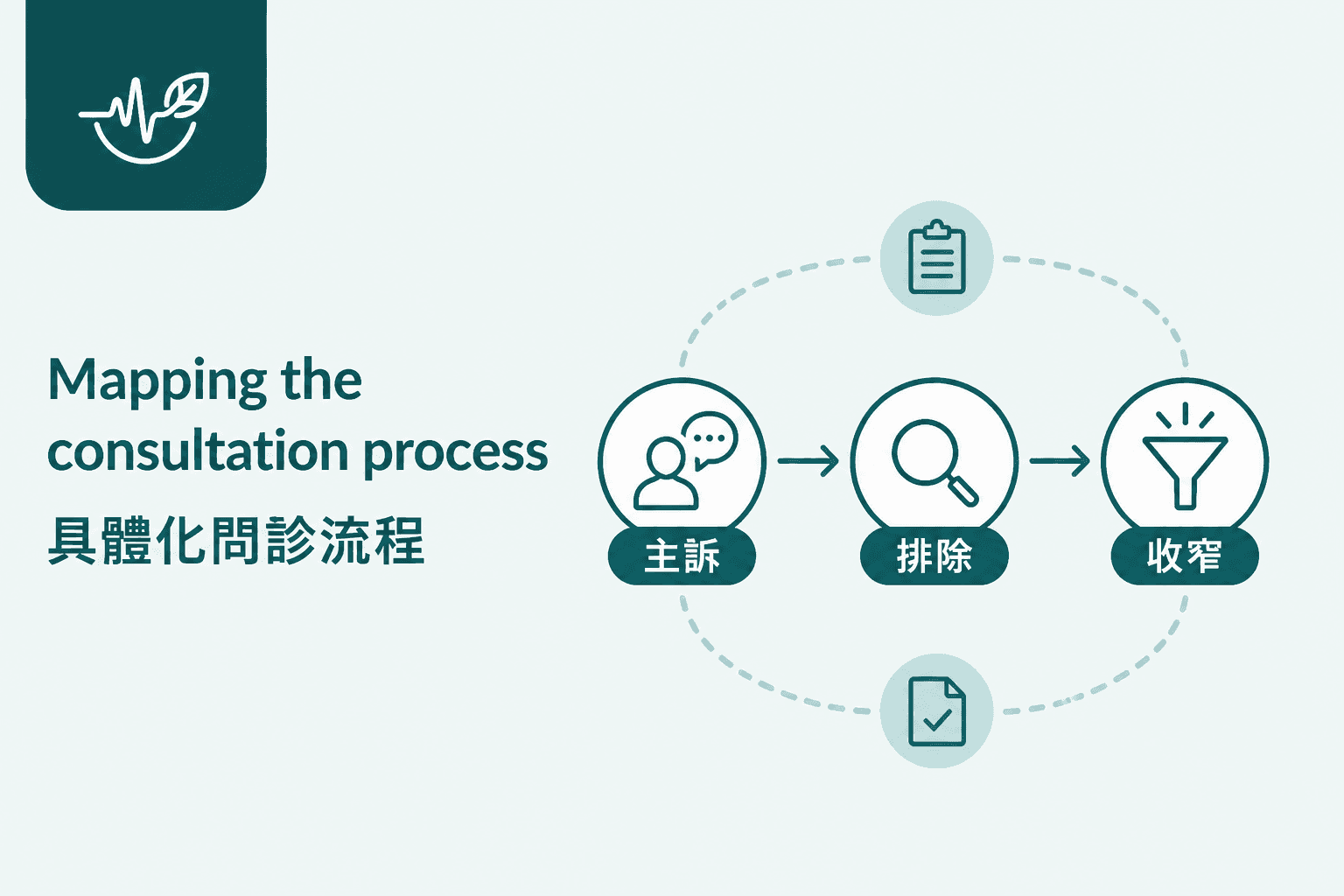
Building NHMCM Clinic started from how practitioners already think through a consult — chief complaint, rule out, narrow — not from software features.
Building NHMCM Clinic has not been a story of adding AI to healthcare and calling it finished.
The hardest part was not the code. The engineering problem wasn't programming. It was externalizing an internalized consultation-and-diagnosis process — how practitioners listen, ask, rule out, and narrow until a case holds together.
Every consult begins with what the patient feels and says: the chief complaint. From there, practitioners establish direction by asking discriminating questions, ruling out what does not fit, and narrowing possibilities. They repeat until the pattern is coherent enough to act on.
Consider a cough. A patient says they have been coughing for two weeks. You ask: dry or productive? Worse at night or with activity? Any fever, chest tightness, or blood? A two-day dry cough after a cold sends you down a different path than a six-week productive cough with weight loss. Each answer redirects the diagnostic path. That reasoning is clinical craft — learned over years, often tacit.
Our consultation agent follows that flow. It is support for practitioner thinking, not replacement. When symptoms are vague or abstract — "I feel off," "something is stuck inside" — structured options, including multiple choice, help patients describe what they mean without forcing medical language they do not have. That is a product insight born from clinical craft, not from a feature brainstorm.
Licensed practitioners keep judgment at every step. The agent organizes the conversation; people decide what it means clinically.
The next build story asks: once you know how to ask, where does the list of possibilities come from?
Continue reading: Grounding the agent in textbook knowledge: why we don't let AI guess →