
Clinic build stories
Grounding the agent in textbook knowledge: why we don't let AI guess
Discriminating questions need a disease landscape. NHMCM retrieves from curated Chinese medicine textbook knowledge — ground every answer in text.
Once consultation flow is mapped, the next question is practical: where does the agent's knowledge come from?
Discriminating questions only work if there is a landscape of possibilities to narrow. A cough might map to many patterns at first — perhaps twenty directions before new information rules some out. That list cannot come from model memory alone.
Large language models can sound confident while guessing. They can hallucinate — presenting plausible patterns that are not grounded in the sources a practitioner would trust. Clinical knowledge cannot rely on that. We ground every answer in text.
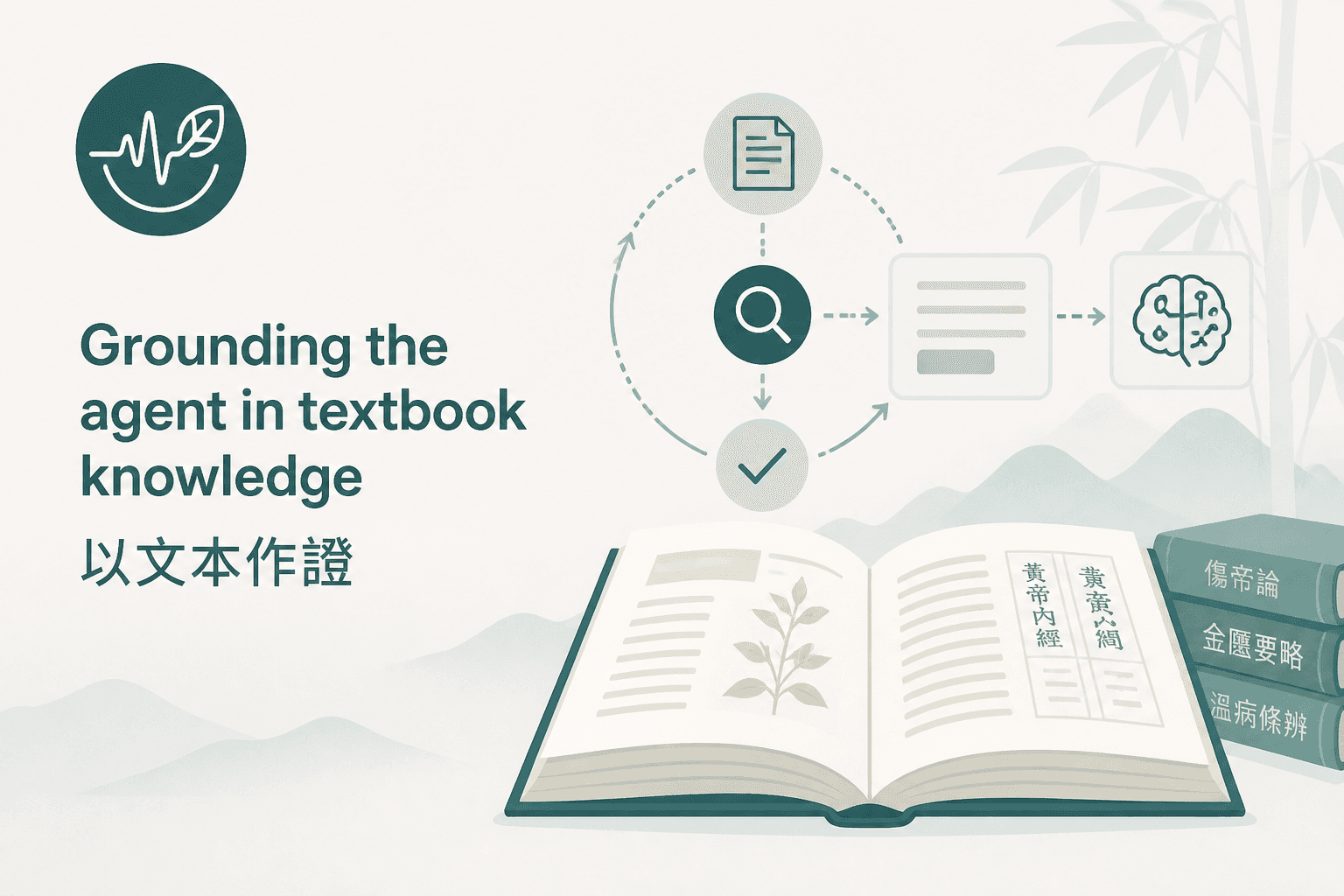
NHMCM uses retrieval-augmented generation over a curated corpus drawn from national standard Chinese medicine textbooks — sources practitioners already trust, prepared for AI-ready retrieval.
The RAG loop works like this: retrieve relevant passages for the chief complaint → read them in context → ask the next discriminating question → retrieve again with updated patient answers → rule out what no longer fits → repeat until the landscape is narrow enough for a licensed practitioner to verify.
Example: cough presented → many possibilities retrieved → duration and character rule out what does not fit → the landscape shrinks with each step.
AI reads the textbooks; people keep clinical responsibility. Licensed practitioners verify diagnosis and treatment — retrieval reduces guessing, it does not eliminate the need for professional judgment or make hallucinations impossible.
The next article asks what happens after diagnosis: one name, many patients, many possible plans.
Continue reading: One diagnosis, many patients: RAG-powered prescription tailoring →