
Philosophy trilogy
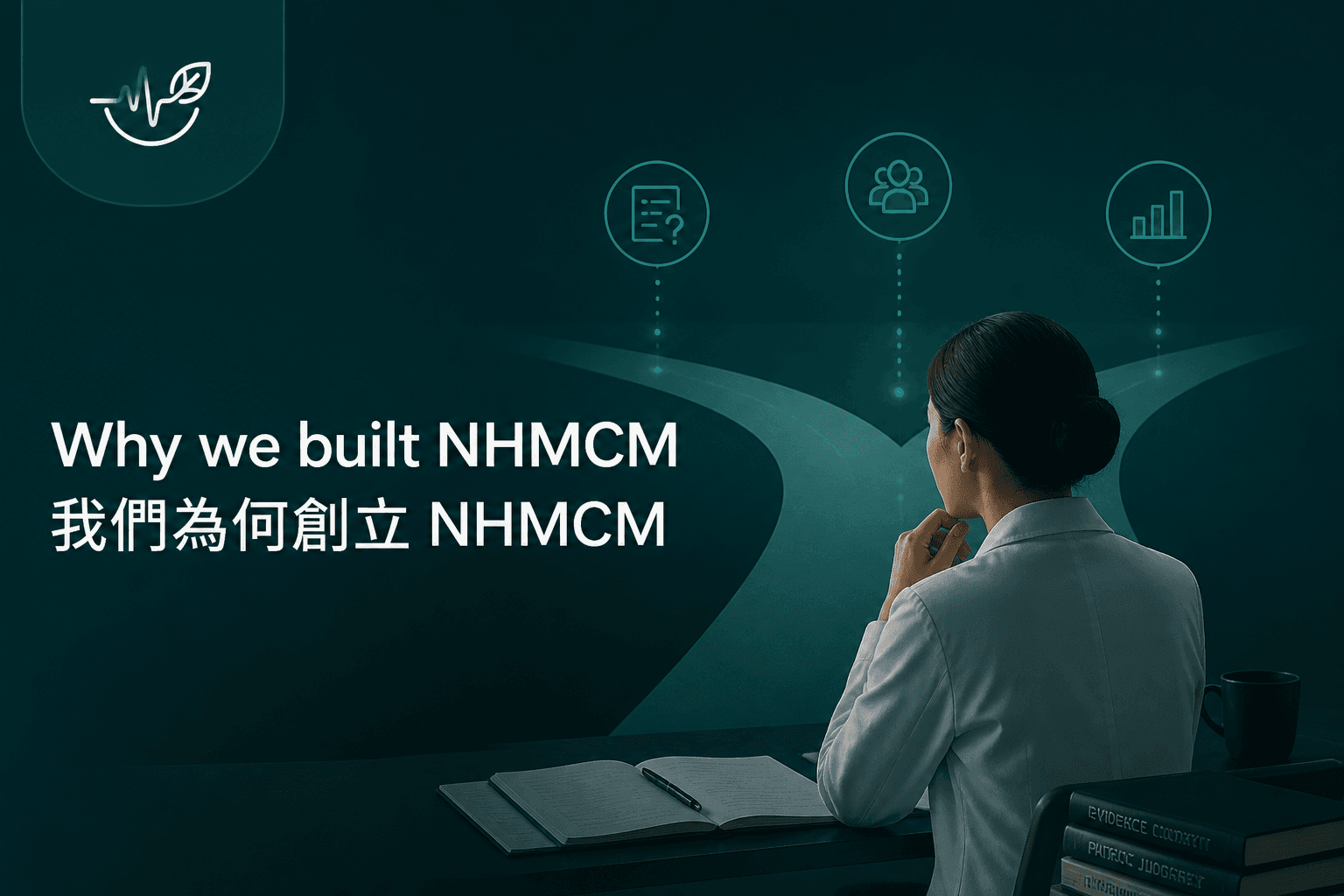
Why we built NHMCM
NHMCM began with one patient and one moment of not knowing — and a conviction that practitioners deserve systems that help them see more before they decide.
Why NHMCM? It started with one patient.
Early in my career, a patient stood up from the treatment table. One side of the body was weak. In seconds I had to decide: was this an ordinary musculoskeletal complaint, or something that needed emergency care right now?
I judged it could be an acute stroke and sent the patient to hospital immediately. They were treated in time. But the question stayed with me: what if I had not known what to look for? What if I had reassured them, adjusted a few points, and sent them home?
That flashback is not unique. Every practitioner remembers being green — supervised exposure thin, reference books open at midnight, standing alone with a case that feels too big for your training. You wonder whether the next decision will help or harm. The weight was not "uncertainty" as a word in a textbook. It was not knowing.
Not knowing whether the symptom pattern you are seeing is benign or urgent. Not knowing whether two herbs interact in a way your training barely touched. Not knowing whether your judgment today is enough for the person in front of you. Symptoms, interactions, limits — that is the real weight.
Incomplete information is normal in clinical work. What is not acceptable is facing hard cases alone, without guidance, without a fuller picture.
That is why we built NHMCM. We are not building an "AI doctor." We are building systems that help practitioners see more, learn faster, and judge with fuller context — while people keep clinical responsibility.
Our vision is evolving Chinese medicine with technology, practitioner-led: infrastructure that helps clinicians carry deep knowledge and cultural trust with more confidence — never replacing it.
This is the first chapter of our seven-part series. The next article explains what we built for practitioners: NHMCM Copilot.
Continue reading: NHMCM Copilot — A co-pilot for Chinese medicine practice →